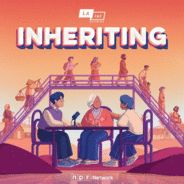
Inheriting-Logo

Kultur & Gesellschaft

Inheriting

Inheriting is a show about Asian American and Pacific Islander families, which explores how one event in history can ripple through generations. In doing so, the show seeks to break apart the AAPI monolith and tell a fuller story of these communities. In each episode, NPR's Emily Kwong sits down with one family and facilitates deeply emotional conversations between their loved ones, exploring how their most personal, private moments are an integral part of history. Through these stories, we show how the past is personal and how to live with the legacies we're constantly inheriting. Learn more at LAist.com/Inheriting

Jetzt anhören
  • im Online-Player
  • im phonostar-Player
  • Was ist das?
    Radio hören mit phonostar Help layer phonostarplayer Um Radio anzuhören, stehen dir bei phonostar zwei Möglichkeiten zur Verfügung: Entweder hörst du mit dem Online-Player direkt in deinem Browser, oder du nutzt den phonostar-Player. Der phonostar-Player ist eine kostenlose Software für PC und Mac, mit der du Radio unabhängig von deinem Browser finden, hören und sogar aufnehmen kannst. ›››› phonostar-Player gratis herunterladen X

Folgen von Inheriting

15 Folgen
  • Folge vom 11.07.2024
    Inheriting Live: How do we talk about our family histories?
    Our final episode of Season 1 is a special "Inheriting" event recorded in front of a live audience. Host Emily Kwong is joined on stage by Bảo Trương (Episode 4), Shakeel Syed and Saira Sayeed (Episode 6), and Leialani Wihongi-Santos and Joseph Aflleje-Santos (Episode 7). They reveal what it was like to tell their stories and explore their family histories on "Inheriting."Then, Emily is joined by "Inheriting" consulting psychologist Sherry C. Wang and ethnic studies post-doctoral lecturer Carol Kwang Park (Episodes 1 & 2) for a robust and informative conversation about how listeners can interview their own family members.For tips on how to conduct family interviews, check out the Inheriting Resource Guide section for Episode 10: https://laist.com/podcasts/inheriting/inheriting-resource-guideStay connected with us! Email us at inheriting@laiststudios.com to share your questions, feelings, and even your story.The show is entirely funded by supporters like you. If you want to hear future seasons, go to LAist.com/Inheriting and click on the orange box to donate.To manage podcast ad preferences, review the links below:See pcm.adswizz.com for information about our collection and use of personal data for sponsorship and to manage your podcast sponsorship preferences.Learn more about sponsor message choices: podcastchoices.com/adchoicesNPR Privacy Policy
    Jetzt anhören
    • im Online-Player
    • im phonostar-Player
    • Was ist das?
      Radio hören mit phonostar Help layer phonostarplayer Um Radio anzuhören, stehen dir bei phonostar zwei Möglichkeiten zur Verfügung: Entweder hörst du mit dem Online-Player direkt in deinem Browser, oder du nutzt den phonostar-Player. Der phonostar-Player ist eine kostenlose Software für PC und Mac, mit der du Radio unabhängig von deinem Browser finden, hören und sogar aufnehmen kannst. ›››› phonostar-Player gratis herunterladen X
  • Folge vom 04.07.2024
    Nicole & the Third World Liberation Front
    Nicole Salaver's uncle, Patrick Salaver, was one of the leaders of the Third World Liberation Front at San Francisco State University in the late 1960s. This movement not only led to the recognition of the term "Asian American," but also brought ethnic studies to colleges nationwide. Pat made a difference in the world as a Filipino civil rights leader, but is largely unknown by the public. Now, Nicole wants to set the record straight and honor her uncle's legacy, while building her own.Follow more of Nicole's work on her show, the Cultural Kultivators Podcast: https://balaykreative.org/cultural-kultivatorsStay connected with us! Email us at inheriting@laiststudios.com to share your questions, feelings, and even your story.Inheriting is entirely funded by supporters like you. If you want to hear future seasons, go to LAist.com/Inheriting and click on the orange box to donate.You can also find resources about the historic events covered in each episode and relevant lesson plans from the Asian American Education Project, including the ones below.Lesson 5.2.1 (Grades 1-5): Asian Americans as Activists and Accomplices https://asianamericanedu.org/activists-activism-accomplices.htmlLesson 4.3 (Grades 7-12): The Fight for Ethnic Studies https://asianamericanedu.org/ethnic-studies-the-fight-to-teach-our-stories.htmlTo manage podcast ad preferences, review the links below:See pcm.adswizz.com for information about our collection and use of personal data for sponsorship and to manage your podcast sponsorship preferences.Learn more about sponsor message choices: podcastchoices.com/adchoicesNPR Privacy Policy
    Jetzt anhören
    • im Online-Player
    • im phonostar-Player
    • Was ist das?
      Radio hören mit phonostar Help layer phonostarplayer Um Radio anzuhören, stehen dir bei phonostar zwei Möglichkeiten zur Verfügung: Entweder hörst du mit dem Online-Player direkt in deinem Browser, oder du nutzt den phonostar-Player. Der phonostar-Player ist eine kostenlose Software für PC und Mac, mit der du Radio unabhängig von deinem Browser finden, hören und sogar aufnehmen kannst. ›››› phonostar-Player gratis herunterladen X
  • Folge vom 27.06.2024
    What does AAPI really stand for?
    Should the acronym "AAPI" even exist? In this special episode, we deconstruct it – tracing the 50-year history of the terms "Asian American" and "Pacific Islander" and interrogating how they are used today. Emily talks with Sefa Aina, associate dean and director of the Draper Center for Community Partnerships at Pomona College. He is also a longtime community organizer who served on President Barack Obama's White House Initiative on Asian Americans and Pacific Islanders. Emily and Sefa also discuss how Pacific Islander experiences are often marginalized in so-called AAPI spaces, leading to misleading data sets, funding inequities, and erasure of history.Stay connected with us! E-mail us at inheriting@laiststudios.com to share your questions, feelings, and even your story.Inheriting is entirely funded by supporters like you. If you want to hear future seasons, go to LAist.com/Inheriting and click on the orange box to donate.To manage podcast ad preferences, review the links below:See pcm.adswizz.com for information about our collection and use of personal data for sponsorship and to manage your podcast sponsorship preferences.Learn more about sponsor message choices: podcastchoices.com/adchoicesNPR Privacy Policy
    Jetzt anhören
    • im Online-Player
    • im phonostar-Player
    • Was ist das?
      Radio hören mit phonostar Help layer phonostarplayer Um Radio anzuhören, stehen dir bei phonostar zwei Möglichkeiten zur Verfügung: Entweder hörst du mit dem Online-Player direkt in deinem Browser, oder du nutzt den phonostar-Player. Der phonostar-Player ist eine kostenlose Software für PC und Mac, mit der du Radio unabhängig von deinem Browser finden, hören und sogar aufnehmen kannst. ›››› phonostar-Player gratis herunterladen X
  • Folge vom 27.06.2024
    Leialani & The Occupation of Guam
    Leialani Wihongi-Santos is CHamoru and was raised on the island of Guam with a distorted view of history. She was taught that the United States "saved" her island from occupation by Imperial Japan. As she's gotten older, Leialani has learned that framing is not entirely true. In some ways, the U.S. military took advantage of the island and the people who live there, sometimes destroying culture and customs that had survived centuries of colonization. Leialani is now determined to understand more of this history from a CHamoru perspective, so she can preserve and teach it to others. In this episode, she turns to her grandpa, Joseph Aflleje-Santos, for answers.Stay connected with us! E-mail us at inheriting@laiststudios.com to share your questions, feelings, and even your story.Inheriting is entirely funded by supporters like you. If you want to hear future seasons, go to LAist.com/Inheriting and click on the orange box to donate.You can also find resources about the historic events covered in each episode and relevant lesson plans from the Asian American Education Project, including the ones below.Lesson 5.8.1.3 (Grades 3-7) - Poetry on Climate Change: Central Ideahttps://asianamericanedu.org/poetry-on-climate-change-central-idea.htmlLesson 5.8.1.2 (Grades 9-12 ) - Pacific Islanders Climate Devastation Poetryhttps://asianamericanedu.org/pacific-islanders-climate-devastation-poetry-grades-9-12.htmlTo manage podcast ad preferences, review the links below:See pcm.adswizz.com for information about our collection and use of personal data for sponsorship and to manage your podcast sponsorship preferences.Learn more about sponsor message choices: podcastchoices.com/adchoicesNPR Privacy Policy
    Jetzt anhören
    • im Online-Player
    • im phonostar-Player
    • Was ist das?
      Radio hören mit phonostar Help layer phonostarplayer Um Radio anzuhören, stehen dir bei phonostar zwei Möglichkeiten zur Verfügung: Entweder hörst du mit dem Online-Player direkt in deinem Browser, oder du nutzt den phonostar-Player. Der phonostar-Player ist eine kostenlose Software für PC und Mac, mit der du Radio unabhängig von deinem Browser finden, hören und sogar aufnehmen kannst. ›››› phonostar-Player gratis herunterladen X