NachrichtenKultur & GesellschaftPolitik
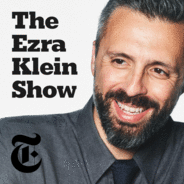
The Ezra Klein Show Folgen
Ezra Klein invites you into a conversation on something that matters. How do we address climate change if the political system fails to act? Has the logic of markets infiltrated too many aspects of our lives? What is the future of the Republican Party? What do psychedelics teach us about consciousness? What does sci-fi understand about our present that we miss? Can our food system be just to humans and animals alike? Subscribe today at nytimes.com/podcasts or on Apple Podcasts, Spotify and Amazon Music. You can also subscribe via your favorite podcast app here https://www.nytimes.com/activate-access/audio?source=podcatcher.
Folgen von The Ezra Klein Show
-
Folge vom 21.02.2023This Book Changed My Relationship to PainPhysical pain is a universal human experience. And for many of us, it’s a constant one. Roughly 20 percent of American adults — some 50 million people — suffer from a form of chronic pain. For some, that means having terrible days from time to time. For others, it means a life of constant suffering. Either way, the depth and scale of pain in our society is a massive problem.But what if much of how we understand pain — and how to treat it — is wrong?Rachel Zoffness is a pain psychologist at the University of California, San Francisco, School of Medicine and the author of “The Pain Management Workbook.” We tend to think of pain as a purely biomechanical phenomenon, a physical sensation rooted solely in the body. But her core argument is that pain is also produced by the mind and deeply influenced by social context. It’s a simple-sounding argument with vast implications not only for how we experience pain but also for how we treat it. She points to numerous underused tools — aside from pills and surgeries — that can help lessen our pain.We discuss how pain serves as “the body’s warning signal”; how our mood, stress levels and social environment can amplify or dial down our pain levels; what phantom limb syndrome says about how the brain “makes pain”; how our emotions and trauma influence our pain levels; the crucial difference between “hurt” and “harm”; why studies on back pain have yielded such bewildering results; how to figure out and improve your personal “pain recipe”; the roots of our chronic pain crisis; how our health care system could be better set up to treat chronic pain; why Zoffness says, “If the brain can change, pain can change”; and more.Mentioned:“Sham Surgery in Orthopedics” by Adriaan Louw, Ina Diener, César Fernández-de-las-Peñas and Emilio J. PuenteduraBook Recommendations:Why Zebras Don’t Get Ulcers by Robert M. SapolskyThe Body Keeps the Score by Bessel van der KolkPain by Patrick WallThoughts? Guest suggestions? Email us at ezrakleinshow@nytimes.com.You can find transcripts (posted midday) and more episodes of “The Ezra Klein Show” at nytimes.com/ezra-klein-podcast, and you can find Ezra on Twitter @ezraklein. Book recommendations from all our guests are listed at https://www.nytimes.com/article/ezra-klein-show-book-recs.“The Ezra Klein Show” is produced by Emefa Agawu, Annie Galvin, Jeff Geld, Roge Karma and Kristin Lin. Fact-checking by Michelle Harris and Kate Sinclair. Mixing by Sonia Herrero and Isaac Jones. Original music by Isaac Jones. Audience strategy by Shannon Busta. The executive producer of New York Times Opinion Audio is Annie-Rose Strasser. Special thanks to Carole Sabouraud and Kristina Samulewski. Subscribe today at nytimes.com/podcasts or on Apple Podcasts, Spotify and Amazon Music. You can also subscribe via your favorite podcast app here https://www.nytimes.com/activate-access/audio?source=podcatcher. For more podcasts and narrated articles, download The New York Times app at nytimes.com/app. Hosted by Simplecast, an AdsWizz company. See pcm.adswizz.com for information about our collection and use of personal data for advertising.
-
Folge vom 17.02.2023The Inflation Story Has Changed Dramatically. Paul Krugman Breaks It Down.In recent months, the story of the U.S. economy has changed significantly. The January Consumer Price Index showed that annual inflation slowed for the seventh straight month. That month, the economy also added over half a million jobs, and unemployment reached 3.4 percent, its lowest level since 1969. In light of these trends, comparisons to the 1970s stagflation crisis have weakened, and the possibility of a “soft landing” looks increasingly likely.But that doesn’t mean we’ve achieved victory. While the headline inflation numbers have looked promising, the devil is in the details. Answers to questions like how fast inflation has actually slowed, whether that slowdown will continue, how likely a future recession is, and how the Fed should act all next come down to which statistics and indicators you are looking at.So I decided to bring on the Times Opinion columnist and Nobel laureate economist Paul Krugman to break down the data and what it says about inflation moving forward. We also discuss the debt ceiling crisis, why the Republican Party has failed to embrace a coherent economic agenda, whether the Biden administration’s industrial policy efforts could undermine its climate objectives, the 20th-century economics book that best explains why the United States has gotten so bad at building things, why Krugman — a longtime advocate of free trade — has come around to embrace greater protectionism, why he believes China’s economic ascendence is no longer inevitable, whether A.I. will replace huge numbers of white collar workers and more.Mentioned:“Recession, Inflation or Soft Landing in 2023?”by Free Expression“We’re Going to Miss Greed and Cynicism” by Paul KrugmanThe Rise and Decline of Nations by Mancur OlsonBook Recommendations:Slouching Towards Utopia by J. Bradford DeLongHow the War Was Won by Phillips Payson O’BrienNinth House by Leigh BardugoThoughts? Guest suggestions? Email us at ezrakleinshow@nytimes.com.You can find transcripts (posted midday) and more episodes of “The Ezra Klein Show” at nytimes.com/ezra-klein-podcast, and you can find Ezra on Twitter @ezraklein. Book recommendations from all our guests are listed at https://www.nytimes.com/article/ezra-klein-show-book-recs.“The Ezra Klein Show” is produced by Emefa Agawu, Annie Galvin, Jeff Geld, Rogé Karma and Kristin Lin. Fact-checking by Michelle Harris, Rollin Hu, Mary Marge Locker and Kate Sinclair. Mixing by Sonia Herrero. Original music by Isaac Jones. Audience strategy by Shannon Busta. The executive producer of New York Times Opinion Audio is Annie-Rose Strasser. Special thanks to Pat McCusker and Kristina Samulewski. Subscribe today at nytimes.com/podcasts or on Apple Podcasts, Spotify and Amazon Music. You can also subscribe via your favorite podcast app here https://www.nytimes.com/activate-access/audio?source=podcatcher. For more podcasts and narrated articles, download The New York Times app at nytimes.com/app. Hosted by Simplecast, an AdsWizz company. See pcm.adswizz.com for information about our collection and use of personal data for advertising.
-
Folge vom 14.02.2023How the $500 Billion Attention Industry Really WorksFor most of us, seeing an advertisement pop up while we’re scrolling on Instagram or reading an article or watching a video is the most banal experience possible. But in the background of those experiences is a $500 billion marketplace where our attention is being bought, packaged and sold at split-second speeds virtually every minute of every day. Online advertising is the economic engine of the internet, and that engine is fueled by our attention.Tim Hwang is the former global public policy lead for A.I. and machine learning at Google and the author of the book “Subprime Attention Crisis: Advertising and the Time Bomb at the Heart of the Internet.” Hwang’s central argument is that everything about the internet — from the emphasis data collection to the use of the “like” button to the fact that services like Google Search and Facebook are free — flows from its core business model. But that business model is also in crisis. The internet is degrading the very resource — our collective attention — on which its financial survival depends. The resulting “subprime attention crisis” threatens upend the internet as we know it.So this conversation is about the economic logic that undergirds our entire experience of the internet, and how that logic is constantly warping, manipulating and shaping the most important resource we have — our attention. But it’s also about whether a very different kind of internet — build on a very different economic logic — is possible.Mentioned:“Does Quora Really Have All the Answers?” by Gary RivlinGoogle report: “5 Factors of Viewability”“Almost Impossible”Book Recommendations:Here Comes Everybody by Clay ShirkyThe Profiteers by Sally DentonJim Ravel’s Theatrical PickpocketingThoughts? Guest suggestions? Email us at ezrakleinshow@nytimes.com.You can find transcripts (posted midday) and more episodes of “The Ezra Klein Show” at nytimes.com/ezra-klein-podcast, and you can find Ezra on Twitter @ezraklein. Book recommendations from all our guests are listed at https://www.nytimes.com/article/ezra-klein-show-book-recs.“The Ezra Klein Show” is produced by Emefa Agawu, Annie Galvin, Jeff Geld, Roge Karma and Kristin Lin. Fact-checking by Kate Sinclair. Mixing by Sonia Herrero. Original music by Isaac Jones. Audience strategy by Shannon Busta. The executive producer of New York Times Opinion Audio is Annie-Rose Strasser. Special thanks to Pat McCusker and Kristina Samulewski. Subscribe today at nytimes.com/podcasts or on Apple Podcasts, Spotify and Amazon Music. You can also subscribe via your favorite podcast app here https://www.nytimes.com/activate-access/audio?source=podcatcher. For more podcasts and narrated articles, download The New York Times app at nytimes.com/app. Hosted by Simplecast, an AdsWizz company. See pcm.adswizz.com for information about our collection and use of personal data for advertising.
-
Folge vom 10.02.2023The Tao of Rick RubinReading Rick Rubin’s production discography is like taking a tour through the commanding heights of American music over the past few decades. Jay-Z. Run-DMC. Beastie Boys. Slayer. The Red Hot Chili Peppers. Johnny Cash. Kanye West. Neil Diamond. Brandi Carlile. Eminem. Adele. And it’s not just his production credits: Rubin co-founded Def Jam Recordings and was a co-chairman of Columbia Records. What’s allowed him to work with so many different kinds of artists, across such a stunning range of genres, so successfully?In his new book, “The Creative Act: A Way of Being,” Rubin turns his philosophy of creativity into a manual for living. It is not, to be honest, the book I was expecting. It is less about music than mind states: awareness, openness, discernment, attunement to nature, nonjudgmental listening, trust in your own taste. It is at once mystical and practical, alive to the tensions of creation but intent on holding them gently. I found it unexpectedly moving.We discuss how Rubin listens to new music, the importance of staying open to the natural world, the difficulty of appreciating art that’s different from what you already like, the rituals that artists like Carlos Santana have when recording, why minimalist composers like Steve Reich are just as “extreme” as heavy metal bands, how Rubin helped Johnny Cash strip down his sound and revive his career, what it takes to level up your taste, the difficulty and gifts of awareness, the relationship between speed and art, how streaming culture is changing our taste, the kind of music that makes Rubin stop and pay attention and oh so much more. This one’s a delight.Mentioned:The Tao Te-Ching by Lao Tzu, translated by Stephen MitchellAmerican Recordings by Johnny Cash"Pulses" by Steve Reich and Erik HallMusic for Wobbling. Music Versus Gravity. by F.S. Blumm and Nils FrahmAlbum Recommendations:Forever Changes by LoveThe Beatles by The BeatlesRamones by RamonesThoughts? Guest suggestions? Email us at ezrakleinshow@nytimes.com.You can find transcripts (posted midday) and more episodes of “The Ezra Klein Show” at nytimes.com/ezra-klein-podcast, and you can find Ezra on Twitter @ezraklein. Book recommendations from all our guests are listed at https://www.nytimes.com/article/ezra-klein-show-book-recs.“The Ezra Klein Show” is produced by Emefa Agawu, Annie Galvin, Jeff Geld, Rogé Karma and Kristin Lin. Fact-checking by Michelle Harris. Mixing by Sonia Herrero. Original music by Isaac Jones. Audience strategy by Shannon Busta. The executive producer of New York Times Opinion Audio is Annie-Rose Strasser. Special thanks to Jon Caramanica, Dan Charnas, Jack Hamilton, Felix Grimm, Carole Sabouraud and Kristina Samulewski. Subscribe today at nytimes.com/podcasts or on Apple Podcasts, Spotify and Amazon Music. You can also subscribe via your favorite podcast app here https://www.nytimes.com/activate-access/audio?source=podcatcher. For more podcasts and narrated articles, download The New York Times app at nytimes.com/app. Hosted by Simplecast, an AdsWizz company. See pcm.adswizz.com for information about our collection and use of personal data for advertising.
